In defense of my grandmother’s facebook habit
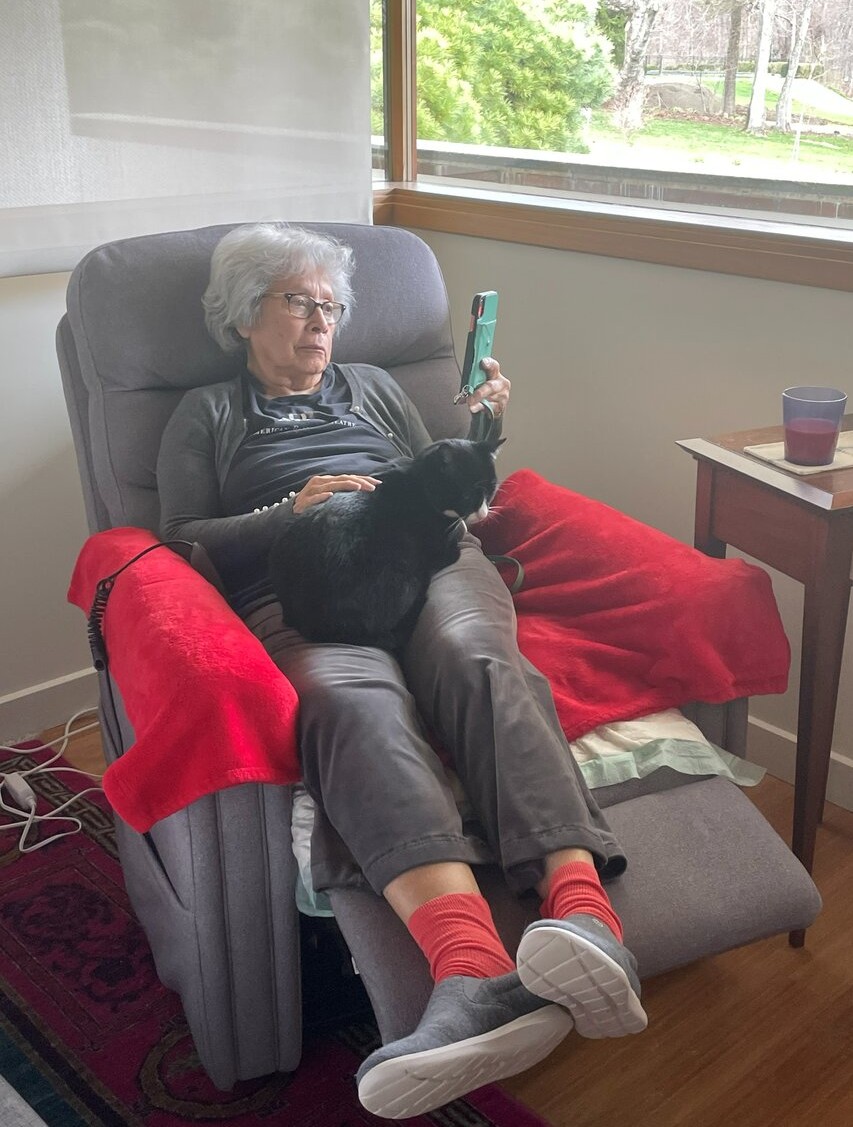
The author’s 91-year old grandmother scrolling through Facebook on her iPhone
We often hear about keeping our brains and bodies agile as we age. Do the crossword, try a puzzle. Though we don’t usually suggest holding a tiny screen up to your face in order to share a cat photo with your grandchild. But some studies show that this may have the same effect – a mental and physical challenge that helps preserve dexterity.
At 91, my grandmother does all of the above: crosswords, the occasional puzzle, ‘Chair Yoga.’ And she takes stylus to screen, to scroll through Facebook. She navigates social media with enthusiasm and a steady stream of questions. How do I share a photo? How do I comment on this post? How do I find that video I once saw with the baby talking in Japanese?
Like many families, we often find ourselves rolling our eyes at the endless stream of videos and soundbites coming out of her phone. The trends served to her on Facebook are often months behind whatever is happening elsewhere online. And as a society we often despair about people spending hours glued to their phones and tablets. But you know what? It makes me smile to look across a room and see my grandmother scrolling on her iPhone.
I do suspect this has a similar mind-and-body-engaging effect as does scribbling on a crossword, or wielding a giant flimsy newspaper at the breakfast table.
Oh, Just Facebook
“What are you watching?”
“Heh?”
“WHAT ARE YOU WATCHING?
“Oh, just Facebook.”
Of course, what else.
When I asked my grandma what she uses social media for, she said she mainly likes to see what other people are doing, and sometimes share her own news. Recently, she posted about a trip to New York, where she visited the United Nations, her former place of employment, and the apartment building where she and my grandfather lived when they were newly married.
Asked what she dislikes about social media, she said too many people post “inconsequential stuff.”
Staying connected
The elderly are a fast-growing group on social media. This brings its benefits: in a loneliness epidemic, these platforms can help people maintain friendships, reconnect with old acquaintances, and stay engaged with the wider world.
For my grandmother, this means keeping in touch with old friends, siblings, nieces and nephews scattered across the globe. Having lived in the Philippines, the United States, Hong Kong, Malaysia and elsewhere, she has accumulated friends in just about every corner of the world. Social media allows her to see snippets of their daily lives and stay connected despite the distances.
There are drawbacks. The media spends a great deal of time discussing media literacy and fake news, generative AI, shrinking attention spans, and the effects of short-form content on younger generations. We talk less about how those same things affect adults, though they must.
But where else can my grandmother watch, on repeat (and repeat) a mash-up of classic MGM dance sequences set to a Bruno Mars song? Where else can she share photographs of her cat, Mr. Max, with friends and family living across countries and time zones?
My grandmother was born and raised in the Philippines, decades before social media existed. She learned to type on a manual typewriter. Today, she spends several hours a day on Facebook. In fact, she was on Facebook today at 1:30am when I arrived at her house after a long journey up from Washington DC, following work on Friday to spend a long weekend together.
That is not to say there have not been any issues. Years ago, she commented on a photograph of me that had been shared by my university. The comment was innocuous but more personal than I would have liked to appear on a public page. Fortunately, a good friend who lived nearby stopped by to help with some internet issues. While she busied herself in another room, he frantically and tactfully deleted the comment and spared me the embarrassment.
And frequently we can hear the soundtrack of a video about some new cure-all medicine that certainly sounds like a scam. Or an advertisement-disguised-as-organic-content announcing that she has just won a brand new iPad.
Still, for all the concerns about misinformation, superficial connections, and endless scrolling, there is something special about watching a 91-year-old engage with a technology that did not exist for most of her life. Social media may not be a substitute for real community, but it does offer connection and joy. And that is why she keeps opening Facebook each morning (afternoon, and night).

Antonia is half-Filipina, half-American, and enjoys spending her weekends with her grandmother, Betty, and Betty’s cat, Mr. Max. When not writing about social media, she is scrolling on social media and making ill-advised Instagram purchases.